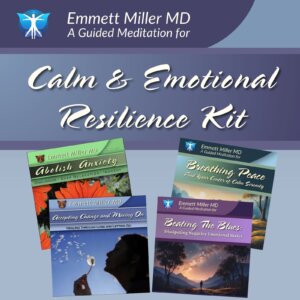
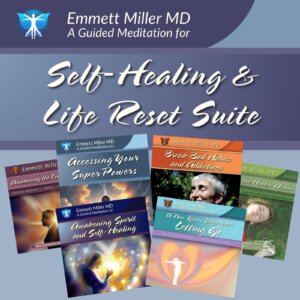
Mind-Body Medicine is the revolutionary approach first introduced by Dr. Miller in the 1970s. It differs from mainstream medicine in that it recognizes the profound connections between mind, body, emotion, and spirit, and harnesses their power to unleash healing and transformation. Mind-Body Medicine comprises a dynamic, all-encompassing paradigm that blends ancient wisdom with modern science to tap the innate healing potential of the human body.
As you may be well aware, whenever something happens to the mind there is an impact on the body, and anything that happens to the body affects the mind in some way. Mainstream medicine for so many years has missed this truth, and has failed to pay attention to and treat both aspects of a patient when there has been trauma to either mind or body.
The Mind-Body discipline recognizes that our thoughts, feelings, and beliefs profoundly impact physical health and well-being. Its approaches to treatment emphasize the fact that human beings are not just a collection of organs and tissues but complex, integrated living systems. This perspective empowers us to take control of our own health by drawing on the vast, untapped reservoirs of wisdom and healing energy that reside within us.
Accessing this potential through a range of transformative practices such as meditation, deep relaxation, hypnosis, cognitive restructuring, and guided imagery, you can unlock the healing power of your mind and body and overcome challenges to your health, happiness, and success. These Mind-Tools will show you how to focus your mind and emotions to promote healing and well-being, and connect with your true Self.
Mind-Body Medicine and Your Emotions
It is important to note that from the beginning, Dr. Miller’s approach has acknowledged that the “Big Four” aspects of Mind, Body, Spirit, and Emotions all contribute to healing, though for ease of reference its name has been shortened to “Mind-Body Medicine.” It is vital to recognize that our emotions are directly produced by the subconscious Limbic System, and commonly serve as the trigger of physical symptoms and illnesses; as well as mood disorders such as anxiety, depression, and rage; and habit disorders such as addiction.
When we have learned to quiet the Limbic System–what Dr. Miller refers to as “the monkey mind”–through Mind-Tools such as meditation, self-hypnosis, or prayer, our higher mind becomes free to deal with the source of our problems through analysis and strategy. By guiding yourself into states of deep relaxation, you can let go of the Monkey Mind’s distracting thoughts and sensations and allow yourself to be present in the “here and now.” Once your awareness is no longer being diverted by disquieting thoughts of the past or anxious projections of the future, guided imagery can begin to work its magic on you. Initially it can take you to a special place–perhaps a sacred place–in your imagination, where body, mind, spirit, and emotions can begin to heal.
In this state, you can gain access to your wisdom and visualize making life choices based on reality and your true abilities. What’s more, this deeply relaxed and focused state frees you to open fully to your inner spiritual guidance.
Mind-Body Medicine and the Spirit
Authentic Mind-Body practitioners always consider the “spiritual” dimension of each patient/client. Each of us has a higher mind, the conscious, intentional, rational, analytical intellect. Most illnesses and dysfunctions represent situations in which the subconscious “monkey mind” is making decisions, triggering emotions and behaviors, and frustrating our conscious intentions. In spite of our good intentions, however, the choices we make to influence this subconscious behavior are often unwise or illogical, usually because they are affected by anxiety and stress reactions that actively inhibit the clear thinking of the conscious mind.
Fortunately, there is another level we might think of as the “spiritual” or philosophical level. We all have this; it is the part of us that storehouses our spiritual principles, our deepest values, our ideal selves. Even if we practice no established religion or faith, we all have personal values and an inner model of the kinds of thoughts, words, and actions we “should” have or perform. higher level is closely allied with the place of wisdom and wise action within. To act wisely is to make a choice in the present that you will look back on approvingly in several weeks, months, or years and think, “that was smart of me.” This is seldom the choice we make when we act out of fear or anger!
The state of deep relaxation is of central value in Mind-Body Medicine because it enables us to bypass the anxiety/stress factor and access the highest sense of who we are or want to be. This is one of the ways Mind-Body Medicine includes our spiritual dimension. It enables us to align our choices with these principles and visualize ourselves behaving according to them in thought word and deed, training ourselves, and rewiring the nervous system.
The Evidential Basis of Mind-Body Medicine
In the 1970s and 1980s, mainstream medical and psychological professionals were hesitant to consider an approach that, although logical and based on sound theory, could boast very few peer-reviewed double-blind studies. Those studies were slow in coming for many reasons, including:
• We did not yet have measuring instruments that could detect the changes the mind was creating (e.g., changes in antibody levels).
• Pharmaceutical companies, the prime source of funding for research, were not interested in proving the efficacy of tools that might massively lower their profits.
• Much longer timeframes are often needed for such studies, compared to the few weeks or months necessary to show the usefulness of a new symptom-reducing drug.
By the 1990s, however, our ability to carry out these experiments had improved, and in the decades since the mind/body approach was introduced, tens of thousands of studies have clearly demonstrated the enormous impact our thoughts, beliefs, and emotions have on every system in the body. Mental and emotional stress has been linked to nearly every illness, right up to and including the top five causes of death: heart disease, cancer, respiratory disease, accidents, and suicide. And to top it all off, some stressors shorten your Telemeres (Telomeres are special DNA sequences that protect the ends of chromosomes from becoming frayed or tangled. and shorten your life.*
For instance, according to The Mayo Clinic, The American Heart Association, and the National Institute of Mental Health:
-
- 43 percent of adults suffer adverse health effects from stress.
- 75 to 90% of all doctor’s office visits are for stress-related ailments and complaints.
- Stress is part of the etiology of physical illnesses, including hypertension, heart disease, diabetes, skin conditions, headaches, asthma, arthritis, and others.
- Stress in the workplace costs American industry more than $300 billion annually.
- 50% of emotional disorders last a lifetime due to chronic, untreated stress reactions.
Meanwhile pharmaceutical companies spend millions or even billions of dollars researching chemicals to treat the symptoms of these illnesses, and producing drugs that sell for exorbitant sums. But what percent of patients who go to a doctor with these diseases will be given tools to treat the underlying source?
On the positive side, many modern training institutions have begun to train students in this new field, but huge systems change slowly, especially when success would lead to significantly lower profits. No doubt that if pharmaceutical companies could make the kind of profits from these techniques that they do from peddling pills to treat symptomatic relief, they would have sold you these mind tools long ago. Dr. Miller offers you these empowering techniques here for small fraction of the cost of mainstream medical care.
Get started now with some samples below.
* Shorter telomere length is associated with advancing chronological age and also increased disease morbidity and mortality. Emerging studies suggest that stress accelerates the erosion of telomeres from very early in life and possibly even influences the initial (newborn) setting of telomere length. Psychoneuroendocrinology. 2013 Sep; 38(9): 1835–1842. (10.1016/j.psyneuen.2013.03.010 – see: https://www.sciencedirect.com/science/article/abs/pii/S0306453013001054?via%3Dihub)
Mind-Body Medicine Audio & Video
-
-
-
-
-
-
-
-
-
-
-
-
Sale!
Heart of Hypnosis and Deep Healing: A Professional Training (3 DVDs)
Original price was: $450.00.$99.00Current price is: $99.00.